.webp)


March 28, 2026
Code
Arabic-First UX Design: Why Translated Interfaces Fail MENA Users
Why translating English interfaces to Arabic fails MENA users, and what Arabic-first UX design actually looks like in practice.

The Problem with Translated Design
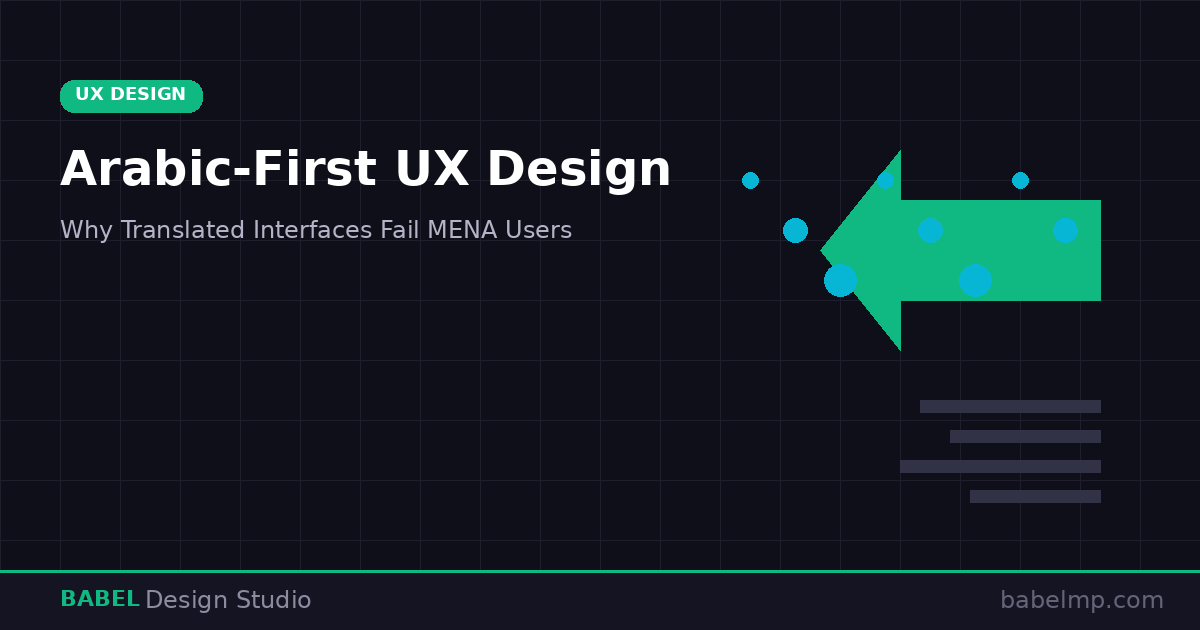
Most international products entering the MENA market take an English interface and translate it to Arabic. They flip the layout from left-to-right (LTR) to right-to-left (RTL), swap the text, and call it localization. But true Arabic-first design goes far beyond translation — and the difference shows in user engagement, trust, and conversion rates.
RTL Is Not Just a Mirror
Mirroring an English interface does not create an Arabic experience. Reading patterns differ: Arabic users scan from right to left, which changes how they perceive visual hierarchy, navigate menus, and interact with forms. Icons that make sense in Western contexts may confuse Arabic users. Even the emotional weight of typography changes — Arabic calligraphy carries cultural significance that generic Noto Sans Arabic cannot match.
Typography Matters More Than You Think
Arabic typography has specific requirements that most design systems ignore. Line height needs to be taller to accommodate diacritical marks. Letter spacing works differently because Arabic script is connected. Many popular web fonts render Arabic poorly at small sizes, making body text hard to read on mobile devices.
Choosing the right Arabic typeface — and pairing it correctly with your English font — is one of the highest-impact design decisions you can make for MENA users.
Cultural Context Shapes UX Patterns
MENA users have different expectations around trust signals, social proof, and communication preferences. WhatsApp is often preferred over email for customer support. Payment flows need to account for cash-on-delivery preferences in many markets. Photography and illustration styles that resonate in Western markets may feel disconnected in the Gulf or North Africa.
What Arabic-First Design Looks Like
Arabic-first means designing for Arabic users from the start, not adapting an English design after the fact. It means choosing typography that honors the script, building layouts that follow natural RTL reading patterns, using culturally relevant imagery, and testing with native Arabic speakers throughout the process.
At Babel, Arabic-first design is not an add-on — it is how we work. Our team designs natively in both Arabic and English, with deep understanding of MENA user expectations. Whether you are building a product for Saudi Arabia, Egypt, or the UAE, we design interfaces that feel native, not translated.


Latest industry trends and expert insights from our team
Keep up with our newest projects, market trends, and expert insights


.webp)
Amr Ismail
founder of Babel
A message from our Founder.
Stay in the loop with our latest work, expert tips, and the bold ideas shaping tomorrow’s brands
© Babel LLC, 2026. All rights reserved
.svg)